
Most people picture the Maldives as one thing: an overwater villa, a private pool and a lagoon that looks retouched. That Maldives is real, and it is worth seeing. But it is only half the country.
The other half is where Maldivians actually live. Until 2009, tourists could not stay overnight on these inhabited islands at all. Then the law changed, and family-run guesthouses opened on local islands across the atolls. Today you can spend a few days eating fish curry in a village café, snorkeling off a public jetty and watching kids play football at sunset, then finish the trip in a villa over the water.
That split trip is arguably the most rewarding way to see the Maldives. You get the culture and the value of a local island, plus the privacy and polish of a resort, in one itinerary. Here is how to plan it.
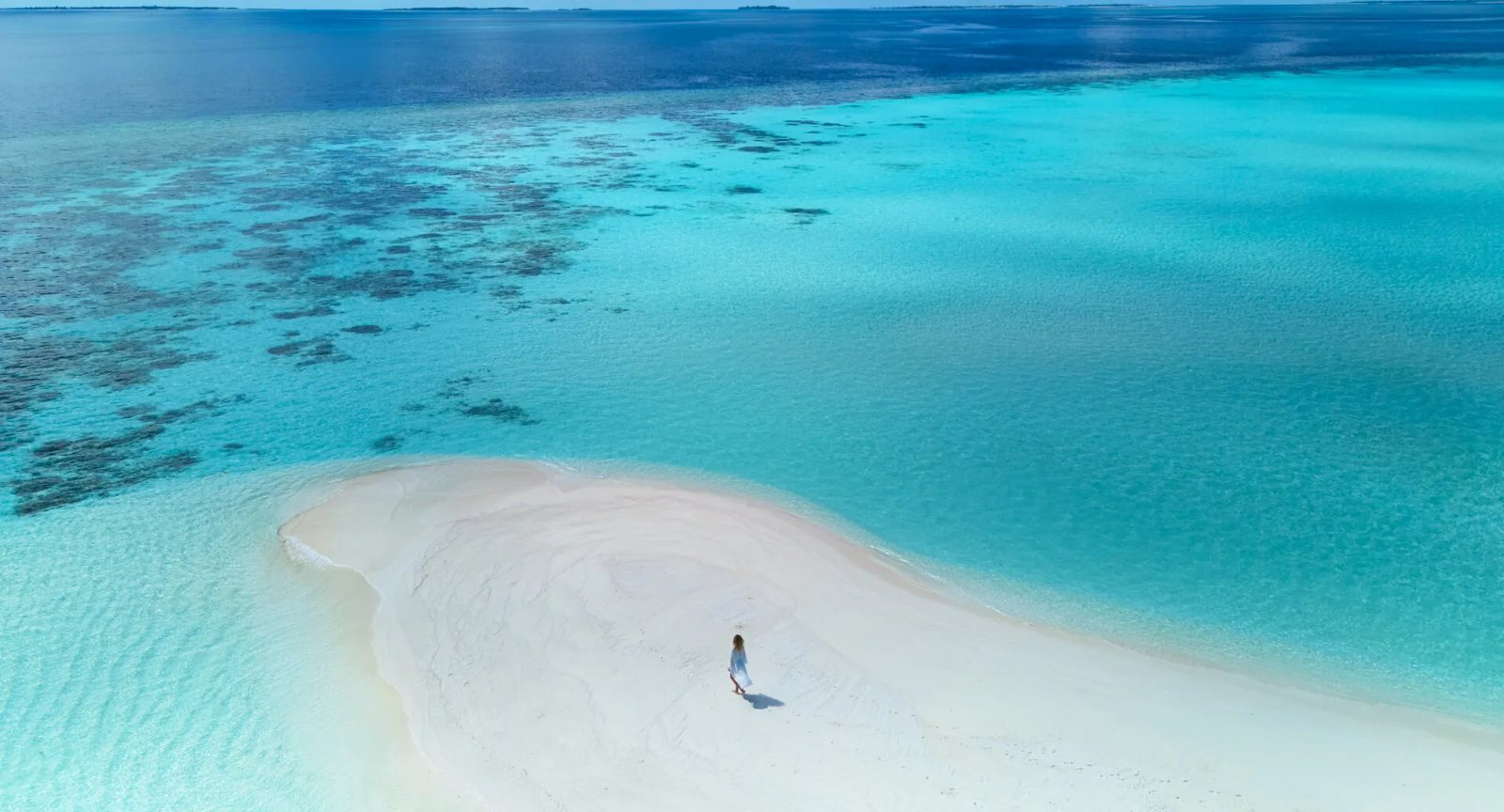
A sandbank in South Ari Atoll. Guesthouses and resorts alike run sandbank picnics, so this is one Maldives moment you can have on any budget. Photo: NH Maldives Kuda Rah Resort.
Local island or resort island: what actually changes
The Maldives runs two kinds of island side by side. On an inhabited island, Maldivian law and local custom apply to everyone, visitors included. On a resort island, which is a private island with nobody living on it but staff and guests, the rules are relaxed.
| Local (inhabited) island | Resort island | |
|---|---|---|
| Where you sleep | Small, family-run guesthouses, legally capped at 50 rooms | Usually one resort per island, from beach villas to overwater villas |
| Alcohol | Not allowed, including in Malé and Hulhumalé | Served freely |
| Swimwear | Only on the designated “bikini beach”; cover up elsewhere | Anywhere on the beach and around your villa |
| Daily life | Mosques, schools, shops, fishing boats, quiet Fridays | Resort staff, restaurants, spa, dive center |
| Green tax | $6 per person per night (guesthouses of 50 rooms or fewer) | $12 per person per night |
| Getting around | Public ferries and shared speedboats | Resort speedboat or seaplane |
The no-alcohol rule surprises people most. It covers restaurants and guesthouses on every inhabited island, so a sundowner means a boat trip to a resort or a liveaboard. Many travelers find a few dry days are part of the point: evenings become sunset walks, night snorkels and long dinners.
How to split the nights
A good rule of thumb is three or four nights on a local island and three to five at a resort. Fewer than three local nights and you barely settle in; more than five resort nights and the days start to blur.
Do the local island first and the resort last. There are three practical reasons:
- Transfers line up with your flight home. Resorts time their speedboats and seaplanes to international departures, so the resort is the easiest place to leave from.
- Public ferries don’t run on Fridays. Only the airport-to-Malé ferry operates, so a Friday departure from a local island is harder to plan.
- You end on a high. After a few days of village life, the resort feels like a reward rather than a default.
Pick a local island that suits the trip. Maafushi, under an hour from Malé by speedboat, has the most guesthouses and daily boat trips, and the busiest feel. Thoddoo is a quiet farming island with a long bikini beach. In South Ari, islands such as Dhigurah sit close to the marine protected area where whale sharks are seen year-round, which makes them a natural first stop before a resort in the same atoll.
Getting between the islands
There are no roads between atolls, so every move is by boat or plane. Most routes start or end at Velana International Airport, on its own island beside Malé.
| Option | Typical cost (2026 estimate) | Time | Good to know |
|---|---|---|---|
| Public ferry (MTCC) | About $1.50 to $3 one way, Malé to Maafushi | About 90 minutes | Cash, tickets at the terminal, no service on Fridays |
| Shared speedboat | About $20 to $25 per person, airport to Maafushi | 45 to 60 minutes | Fixed departure times; check them in advance |
| Private speedboat | About $150 to $250 per boat to Maafushi | 30 to 45 minutes | Leaves when you want |
| Seaplane to a resort | About $700 to $1,900 per adult, shared, round trip | 15 to 90 minutes | Daylight only, booked by the resort |
To move from a local island to a resort, the simplest route is usually back to the airport by speedboat, then onward on the resort’s own transfer. Ask the resort whether its boat can collect you from a nearby island instead: some will, for a fee. Leave a buffer of several hours if a seaplane is involved, because seaplanes don’t fly after dark.
Local-island etiquette and practical tips
Local islands are welcoming, and a little respect goes a long way.
- Cover up in the village. Shoulders and knees covered away from the bikini beach. Throw a T-shirt and shorts or a sarong over your swimwear on the walk back.
- Use the bikini beach for swimwear. It is usually a screened stretch of sand set aside for visitors. Not every local island has one, so check before you book.
- Expect quiet Fridays. Friday is the main day of prayer, shops close around prayer times and ferries don’t run.
- Leave the alcohol for the resort. It isn’t served on local islands, and you can’t bring your own: skip the duty-free, because alcohol is confiscated on arrival at Velana airport.
- Bring some cash. Small cafés, ferries and island shops often work in cash, in US dollars or Maldivian rufiyaa.
- Say hello. “Assalaamu alaikum” is the usual greeting, and “shukuriyaa” means thank you.
In return you get things no resort can offer: snorkeling straight off the beach on many islands, sandbank picnics with your guesthouse, fishing with the boat crew and the chance to see how islanders live.
Choosing the luxury half
The resort is the part of the trip that costs the most, so it pays to choose it carefully. Four questions narrow it down quickly.
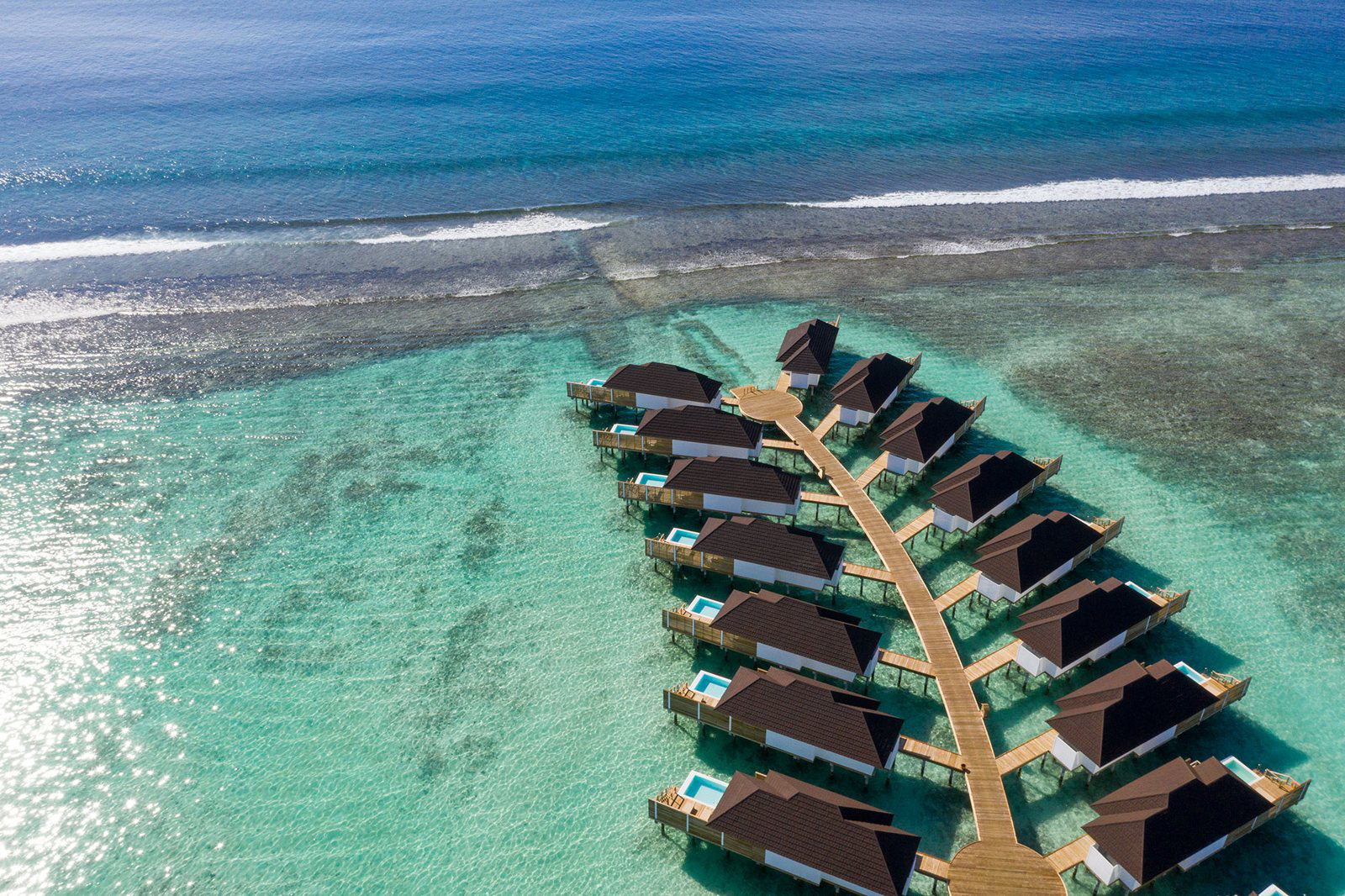
Overwater villas over the reef in South Malé Atoll, a short speedboat ride from the airport. Photo: Sun Siyam Olhuveli.
- Which atoll? Stay in the same atoll as your local island if you can. A South Ari guesthouse pairs well with a South Ari resort; a Maafushi stay pairs with resorts close to the airport, where the transfer is a short speedboat ride.
- Seaplane or speedboat? Resorts within roughly an hour of the airport use speedboats, which run day and night. Farther resorts need a seaplane, which adds cost and daylight-only timing.
- Overwater or beach villa? Overwater villas are the icon. Beach villas usually have more space and more privacy from neighbors, and many have their own pool.
- Which meal plan? Breakfast only, half board or all-inclusive changes the final bill more than most people expect, because resort meals and drinks are priced on top of the room.
For a side-by-side look at luxury resorts by atoll, villa type, and transfer, the luxury holiday guides from HolidayVibe Maldives, a licensed travel agency based in Malé, are a useful place to start. Whatever you choose, ask for every tax and transfer to be shown in the quote, not added later.
What it costs
The split trip saves money because the cheaper nights come first and the transfers on the local side cost very little. Expect these line items (2026 estimates):
- Green tax: $12 per person per night at resorts, $6 at guesthouses with 50 rooms or fewer.
- Resort taxes: most resort bills add a 10% service charge and 17% tourism GST, which together add about 28.7% to the published rate.
- A luxury villa: an overwater villa with a private pool runs about $1,500 to $3,000 a night for two before tax.
- Getting there: a shared seaplane costs about $700 to $1,900 per adult round trip; a speedboat resort near Malé costs far less.
- Local-island transport: a few dollars by public ferry, or about $20 to $25 by shared speedboat.
A worked example for the resort half: four nights in a $1,500 pool villa for two comes to about $1,930 a night once service charge and tax are added, plus $24 a night in green tax. That is roughly $7,820 for the four nights, before meals and before a seaplane of about $1,400 to $3,800 for two. Rates move with the season, so treat these as a planning range and get a live quote for your dates.
Two sample itineraries
Seven nights, close to Malé
| Nights | Where | What to do |
|---|---|---|
| 1 to 3 | A local island near Malé, such as Maafushi | Sandbank picnic, reef snorkeling, sunset on the jetty |
| 4 to 7 | A speedboat resort in North or South Malé Atoll | Villa time, spa, a private dinner, an easy transfer home |
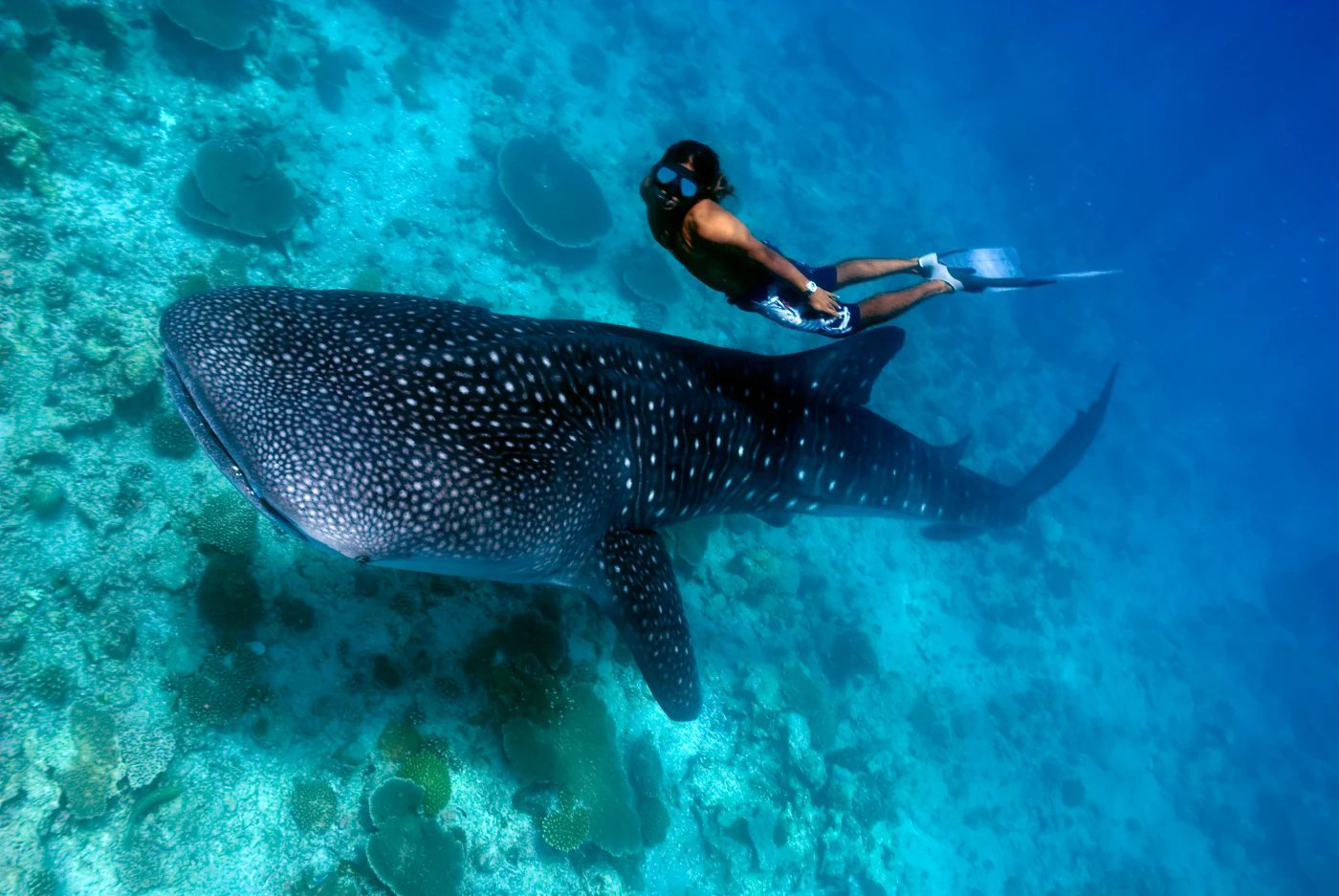
A whale shark encounter in South Ari Atoll, where whale sharks are seen in every month of the year. Photo: OUTRIGGER Maldives Maafushivaru Resort.
Ten nights, built around marine life
| Nights | Where | What to do |
|---|---|---|
| 1 to 4 | A local island in South Ari, such as Dhigurah | Whale shark snorkel trips, house reef, island life |
| 5 to 10 | A resort in Ari Atoll | Overwater villa, diving or more snorkeling, slow days |
South Ari islands are reached by shared speedboat from the airport or by a domestic flight to Maamigili and a short boat ride.
The best of both Maldives
A resort-only trip shows you a beautiful version of the Maldives. A split trip shows you the country. Spend the first nights where Maldivians live, learn a few words of Dhivehi, eat what your guesthouse cooks, and then let a resort take over for the finale. You will fly home having seen both sides of the Maldives, and the contrast is what stays with you.
